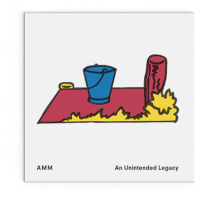
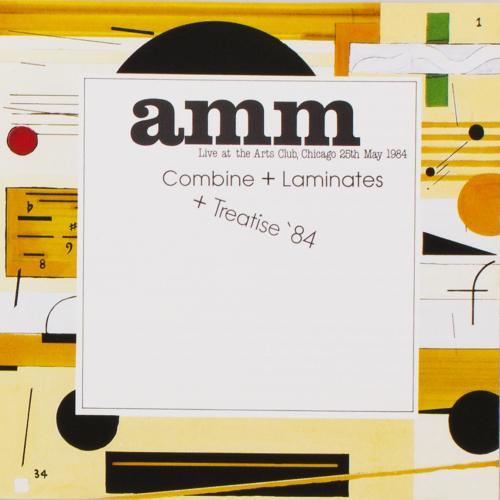
The following text accompanied the Pogus Productions LP which featured Combine + Laminates.
“Mistakes in and towards AMM could be due to constant references to sets of standards†- sleeve note: AMMMUSIC, Elektra 256, recorded 1966 (re-released with other material, RéR AMMCD, 1990).
Twenty-five years on and world political thinking is still asphyxiated by numerous variants of neo-platonism; a creed which engineers the western passion for progress. The market technocratic religion may indeed deliver an increasingly sophisticated diet of material consumables, but the rub is that it demands obedience to the ever moving spirit of consumption. Accept the goods and you must accept the rationale of their production: make-buy-consume-make.
All this may seem a far cry from AMMmusic and the statement above, but it follows that a technocracy is tied to notions of standards and to obtainable, even if at times difficult, reference points. The machine will not work, and therefore not produce, if it is not engineered, maintained and controlled in the prescribed way. The idea of the perfectible object permeates our culture and even musicians become passive, naive and complementing ciphers for such socio-economic goals, by lending their lives to the realisation of ‘perfect’ performances.
In this respect the problem for AMM is that a recording of a fluid, living, fragile and transient performance becomes fixed in vinyl. And, through repeated listenings, maybe it too becomes a musical object with learnable sequences, anticipated movements and awaited resolutions. Such responses are contrary - even alien - to the practice of making AMMmusic. And we connive uneasily with this contradiction because we want the music to live beyond, to transcend, its living moment. But even if the mode of making AMMmusic discourages the development and references to sets of standards, there are constants in AMM’s ethic of improvisation. One such is the tacit acknowledgement of potential failure at every music making moment. At the same time we know that so often failure is at the root of unlooked for success. It is as if the desire and design for success precludes other kinds of development that might arrive fortuitously: learning to accept the results of a hand slip and being open enough to interpret and use what the mind might glimpse as a cloud interrupts the sun.
Of course many of the discoveries of science or expressions of art arrive, apparently, as much through accident as design. Given that human beings regularly use only two or three percent of their neural potential this should be no surprise. There should be even less surprise that heated human imagination also thrusts many irrelevant mutations upon the world. The neo-classicists and their technocratic offspring no doubt would like to harness this potential by way of think-tank and computer models. But ultimately art defies such methods because it does not, cannot, look for specific results without damaging the very potency of the creative method. In the process of dismantling the known in pursuit of the unknown we can only ever be, at best, in the twilight world of the controlled accident.
Eddie Prévost 1990.
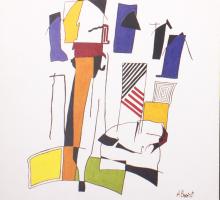
The difference in the music included on this CD version is the addition of Treatise ‘84. This, as the audience was aware, was an improvisation inspired and guided, rather than dictated or controlled by Cornelius Cardew’s graphic masterpiece. There is, of course, no way that this work could be identified as a composition in the accepted sense. There is no universal correlation between the symbols on the page and the sounds the musicians make. Cardew gave no indications as to what any of his graphics might represent. Later, in the Treatise Handbook he offered thoughts upon how such a musical engagement might develop. Nothing however was prescriptive.
Dated entry in Treatise Handbook :
“15th January 1966. Joining AMM was the turning point, both in the compositions of Treatise and in everything I have thought about music up to now. Before that Treatise had been an elaborate attempt at graphic notation of music (which I can only describe as a graphic score that produces in the reader, without any sound, something analogous to the experience of music), a network of nameless lines and spaces pursuing their own geometry untethered to themes and modulations, 12 note series and their transformations, the rules or laws of musical composition and all the other figments of the musicological imagination.â€
Given how much playing in AMM shaped Cardew’s ever evolving views about music our subsequent performances of Treatise are as much a dedication and a celebration of his life and work - cut short all too early. To quote again from the handbook:
“What I hope is that in playing this piece each musician will give of his own music - he will give it as his response to my music, which is the score itself.â€
There is, as may be discernible, a more measured approach to the performance of Treatise ‘84 than to Combine + Laminates . To a large extent the sounds are more arbitrary. Our ‘treatment’ is an intuitive, a creative and above all a very personal response to the graphics, which in some way screens the interplay characteristic of an improvisation. Whilst in the making of AMMmusic proper the musicians are less inhibited and the music flows in a more organic fashion. The relationship between players is more direct and dialogical. At its best the idea of Treatise is an intermediate stage between the instructions of a composer i.e. notation and spontaneous music making. It should lead, as it did for Cardew himself, to an association of music making free of constraint, free of market-relations and full of a positive spirit of community.
Eddie Prévost
1995

![View your cart items []](/modules/contrib/ecommerce/cart/images/cart_empty.png)